
TWO-PHOTON POLYMERIZATION
Technology

Principle
Based on the non-linear two-photon absorption phenomenon, our technology creates a solid 3D-printed structure from a photoactivable material. The laser is focused by an objective into the photoresist, which is transparent at the wavelength used by our pulsed laser (532 nm). However, at the focal spot only, the photoresist can absorb multiple photons simultaneously in a very small volume called “voxel”. A chemical reaction starts, and the liquid monomer becomes a solid polymer inside the voxel.
Led by our proprietary software, the microFAB-3D laser moves freely inside the material to create a solid structure, both through unpolymerized and polymerized parts; therefore, any 3D shape can be created: overhangs without supports, volumes inside others, hollow channels...
A unique green-laser based technology
The two-photon polymerization (2PP) technology used in microFAB-3D systems is the result of 15 years of fundamental research at the University of Grenoble Alpes (UGA), the first scientific publications dating from 2002. This research allows Microlight3D to bring 3D printers to the market with unique characteristics, in terms of highest printing-resolution, compactness, and flexibility of use. It also provides better reliability because these industrial lasers last a very long time with no need for yearly maintenance.
A wide range of materials can be used, such as various photo-polymers, bio-compatible materials, and even proteins and other biomaterials.


Resolution
The photoresist, the wavelength of the laser and the objective used for the fabrication have an impact on the printing resolution. Our 532 nm wavelength ensures therefore a ultra-high 3D-printing resolution below 0.2 µm, using a 1.25 numerical aperture immersion objective. Some microFAB-3D users have achieved a lateral resolution in a 3D structure of less than 100 nanometers. Objectives can be swapped with the turn of a wheel, adjusting the resolution instantly, which opens the door to faster prints with up to 3 µm wide voxels.
Alignment
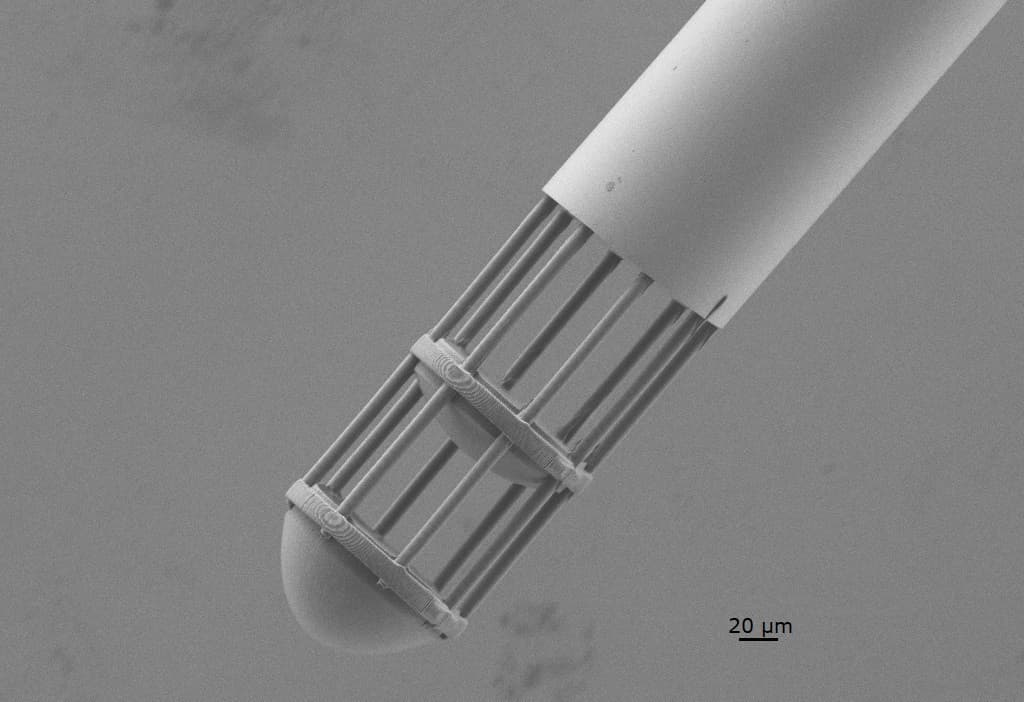
microFAB-3D is equipped with a feedback camera and a dedicated software feature giving you the ability to align and print directly on already-patterned substrates, or even the tip of optical fibers. Using the starting point of the fabrication and the imprint of the 3D model on the camera, you can easily and finely adjust the 3D-object location with a less than 1 µm precision.
Scientific publications
The Microlight3D two-photon polymerization
technology was used for many publications:
Quantifying cell traction forces at the single-fiber scale in 3D: An approach based on deformable photopolymerized fiber arrays — October 2025
Near-infrared plasmonic-based fluorescence enhancement by silver-coated polymer pillar metasurfaces — April 2025


